
For decades, the Costa del Sol and the Costa Blanca have been the obvious destinations for international buyers looking for property in Spain. Marbella, Málaga, Alicante and Benidorm are already established brands, but their success is not based on image alone. Infrastructure has played a major role: international airports, motorways, high-speed rail and dense public-transport networks have made these regions easy to reach.
Costa de Almería starts from a very different position. Mojácar, Garrucha, Vera, Vera Playa, San Juan de los Terreros and the Mar de Pulpí area have long been attractive coastal destinations, but one of the region’s main disadvantages has always been accessibility. In practice, visitors and owners have often needed a car, a rental vehicle or a relatively long airport transfer. That has not made the coastline less attractive, but it has narrowed the group of buyers willing to consider it seriously for a second home, weekend property or investment.
This is precisely why the arrival of AVE and the related rail infrastructure could matter more here than in markets that are already exceptionally well connected.
Murcia–Almería: joining Spain’s high-speed rail network
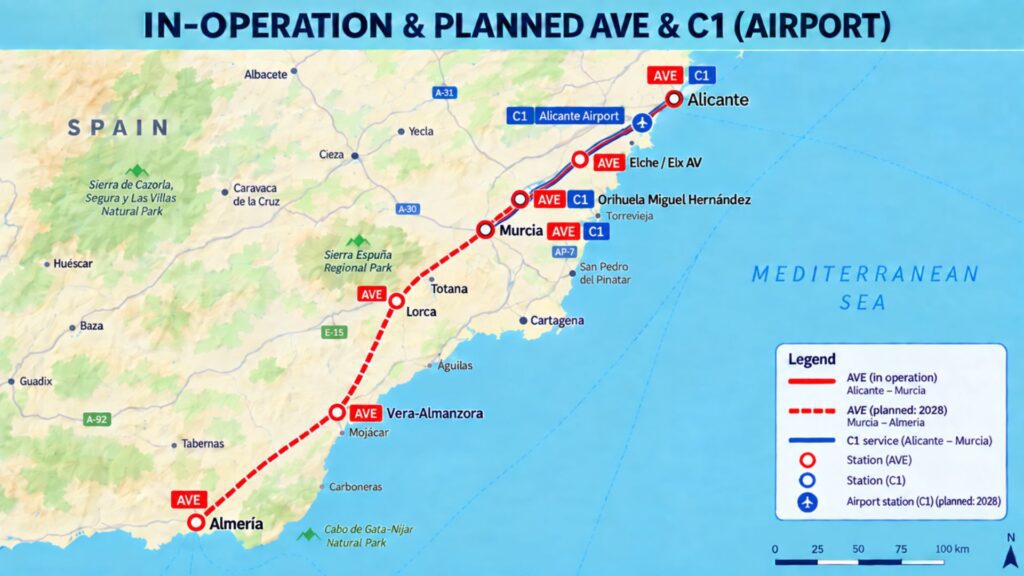
The new high-speed railway between Murcia and Almería is one of the strategic components of the Mediterranean Corridor. For long-distance passenger services, the key stations will be Murcia, Lorca, Vera-Almanzora and Almería.
For eastern Almería, this is a structural change. Mojácar, Garrucha, Vera, Vera Playa, Cuevas del Almanzora and, further north, San Juan de los Terreros and Mar de Pulpí will all become much better connected to Spain’s national rail network.
The Dunas de Vera project documentation, for example, places the future Vera-Almanzora high-speed station at roughly a five-minute drive from the resort.
But the real significance is not simply faster travel between Vera and Murcia. The key city is Madrid.
The new infrastructure should make it possible for the eastern Costa de Almería to be reached from Madrid in roughly four hours by rail, depending on the final Renfe timetable and stopping pattern. That timetable has not yet been published, so this should not be treated as a guaranteed journey time. From an investment perspective, however, the more interesting way to think about it is the other direction: Mojácar, Vera and the surrounding coastline could become roughly four hours from Madrid.
That changes the psychology of a second-home market.
A Madrid family makes one kind of decision if reaching the coast means five or six hours by car, or a flight plus a rental car. It makes another decision if it is possible to board a train on Friday afternoon and be at the coast by the evening.
One of the least visible but most powerful factors in real estate is this reduction in “mental distance”. The investment analysis prepared for Dunas de Vera makes the same point: high-speed rail can turn places previously perceived as “far away” into realistic weekend destinations for Madrid and other major cities.
Alicante Airport: another important step on 5 October 2026
The second infrastructure project is at least as relevant for international buyers.
Alicante-Elche Miguel Hernández Airport is one of Spain’s most important international leisure airports, yet it still has no direct railway station. That is expected to change.
On 5 October 2026, Spain’s Ministry of Transport formally approved the informative study for the Torrellano railway bypass. One of the project’s stated objectives is to provide a direct rail connection to Alicante-Elche Airport and improve rail services along the Alicante–Murcia corridor. The first phase is dedicated to airport rail access, while the wider Torrellano project integrates that connection into Alicante’s railway network.
Spanish Ministry of Transport – Variante de Torrellano, 5 October 2026
The corresponding BOE documentation confirms the same network logic: the airport-access phase connects the airport directly into the corridor, while the subsequent section provides the connection towards Alicante Terminal.
BOE – Torrellano environmental approval
In practical terms, Alicante Airport is expected to become part of the C1 Alicante–Murcia rail axis.
The exact commercial opening date has not yet been announced by Renfe, so the current 2028 target should be treated as a planning date rather than a guaranteed opening date.
For the Costa de Almería, the important point is that these two infrastructure projects connect with each other. From Alicante Airport, passengers should be able to travel by C1 towards Murcia, and from there continue on the high-speed line through Lorca and Vera-Almanzora towards Almería.
For an international owner, this potentially brings the region into the catchment area of three airports:
Almería, Murcia and Alicante.
That is highly relevant for both second-home use and rental demand.
Property prices have already risen — but that is not the most interesting part
At first glance, Costa de Almería does not look like an undiscovered market. Like most of Spain’s Mediterranean coast, it has already experienced strong price growth over the last few years.
Using Idealista’s province-level asking-price index for a broadly comparable four-year period, Almería province rose from approximately €1,129/m² in September 2022 to €1,673/m² in September 2026, an increase of around 48%, equivalent to roughly 10.3% annualised growth.
Over the same period, Alicante province increased to around €2,767/m², while Málaga province reached approximately €4,317/m² in September 2026.
Idealista – Almería province historical prices
Idealista – Alicante province historical prices
Idealista – Málaga province historical prices
These are asking prices rather than completed transaction prices and are therefore best read as indicators of market direction rather than exact investment returns.
But for today’s investor, the more important point is not who performed best over the last four years.
A buyer today is not buying the last four years of performance. The buyer is buying the next four to eight years.
And that changes the perspective.
Almería still sits at a substantially lower price level than both Alicante and Málaga, while one of the structural weaknesses that has historically held the region back — accessibility — is now being addressed.
In a mature market, an investor is already paying for the infrastructure, international visibility and strong historical performance. In a catch-up market, the opportunity lies in identifying changes that may not yet be fully reflected in current prices.
In other words, the question is not where prices rose most yesterday. The better question is where the conditions for future demand are changing most dramatically.
Mojácar, Vera, Garrucha and Pulpí: this is not one town’s story
For that reason, it would be a mistake to treat this simply as a Vera Playa story.
The future Vera-Almanzora station serves a much wider coastal area. Its natural catchment includes established destinations such as Mojácar and Garrucha, Vera and Vera Playa, Cuevas del Almanzora, and further north San Juan de los Terreros and Mar de Pulpí.
These locations have different characters and attract different buyers — and the range of real-estate products is becoming increasingly sophisticated.
Macenas Mediterranean Resort: luxury resort living in Mojácar
In Mojácar, one of the most ambitious examples is Macenas Mediterranean Resort, a luxury resort backed by the Cosentino family and developed between the Mediterranean coastline and the golf course.
The residential offer includes projects such as Las Terrazas, Los Altos and Las Villas, alongside golf, restaurants, a social club and other resort facilities.
Macenas is also moving into a new hospitality category with the arrival of a Destination by Hyatt hotel, bringing an internationally recognised luxury hotel brand to this part of the Costa de Almería.
For second-home buyers, another important feature is that Macenas is not purely a lifestyle proposition. Owners can also make use of professional holiday-rental management, allowing them to generate income during periods when they are not using their property.
This applies across different parts of the resort, including developments such as Las Terrazas, making it possible to combine private ownership with professional rental management without turning the purchase into a traditional hotel-style investment.
That distinction is important. A buyer can own a high-quality residence in a fully integrated luxury resort, use it personally and, if desired, place it into a managed rental programme during unused periods.
Dunas de Vera: a more structured tourism-management model
Dunas de Vera Resort represents a different type of product.
The development consists of seven apartment blocks and 44 villas in a beachfront setting, with an integrated private beach area, outdoor and heated pools, beach club, gym, sauna and other shared facilities.
Its location also illustrates the relevance of the new railway infrastructure: the project’s own documentation places the future AVE station approximately five minutes away by car.
From an investment perspective, what makes Dunas de Vera distinctive is its organised tourism-management structure.
Under the presented operating model, owners can use their property personally for up to two months per year without penalties or additional charges, while the property can be professionally managed during the rest of the year. Owners are also given access to an online platform where they can monitor the performance of their property and receive quarterly management reports.
The project’s forecast materials show estimated owner ROI figures above 5% for different unit types. However, the documentation itself explicitly states that these figures are projections and should not be regarded as legally binding or guaranteed returns.
The operating partner, Checkin Hotel Group, states in its corporate presentation that it has been active since 2013 and specialises in the management, sales and distribution of tourist accommodation.
This makes Dunas de Vera closer to a professionally managed tourism-investment concept than a conventional holiday apartment.
Mar de Pulpí: a more traditional residential model
Mar de Pulpí, in San Juan de los Terreros, offers another alternative.
It is fundamentally a traditional Mediterranean residential development with apartments, gardens, swimming pools, sports facilities and a beachfront environment. It is not a condo-hotel, and owners retain considerably greater flexibility over personal use.
At the same time, professional holiday-rental infrastructure is available in the area, allowing owners who wish to do so to combine personal use with rental activity.
These three examples illustrate how diverse the market is becoming.
Macenas offers an integrated luxury-resort environment with an international Hyatt hotel and optional rental management. Dunas de Vera offers a more structured tourism-management concept. Mar de Pulpí remains closer to traditional residential ownership, with the possibility of professional holiday letting.
That variety matters because the infrastructure story is not about one development or one town. It is about a broader stretch of the eastern Costa de Almería — from Mojácar and Garrucha through Vera to San Juan de los Terreros and Mar de Pulpí — becoming significantly easier to reach at the same time as the quality and diversity of its real-estate offer is increasing.
Costa de Almería: the same Mediterranean, but a different climate
Costa de Almería is not simply a cheaper version of the Costa del Sol or Costa Blanca.
Its climate is noticeably different.
Almería, and particularly the Cabo de Gata–Níjar area, is one of the driest parts of Spain. The landscape is more semi-arid, open and dramatic than Málaga or much of Alicante.
Long-term AEMET climate normals show that January in Almería averages a daytime maximum of around 16.9°C and a nighttime minimum of approximately 8.3°C. Alicante is around 17°C and 6–7°C, while Málaga is approximately 17°C and 7–8°C.
In August, the differences in daytime maximum temperatures are much smaller, with all three regions generally around the low 30s Celsius.
The bigger distinction is rainfall.
Almería is considerably drier than Málaga and generally drier than Alicante, with fewer wet days across the year.
For second-home owners, this dryness has a very practical advantage: fewer rainy days mean a better chance that a week spent at the property will actually feel like a Mediterranean escape, rather than being lost to unsettled weather.
That may sound like a small detail, but for someone who uses a property for short stays rather than living there year-round, weather reliability can be a meaningful part of the decision.
Sea temperatures are also attractive for a long season. Around the eastern Almería coast, the sea is typically warmest in late summer, reaching roughly 25–26°C, while winter temperatures are generally around 15°C.
SeaTemperature.info – Almería sea temperatures
Compared with Málaga, where Atlantic influence tends to keep the sea cooler, the eastern Almería coastline can offer noticeably warmer water during the main summer season, while remaining broadly comparable with parts of the Costa Blanca.
The result is a coastline with a very different identity.
Cabo de Gata’s volcanic landscape, Mojácar’s whitewashed old town, Garrucha’s marina and fishing tradition, Vera’s wide beaches and the quieter scale of San Juan de los Terreros create a region that feels very different from the more intensively developed sections of the Costa del Sol and Costa Blanca.
The key question is not what happened yesterday
The investment case for Costa de Almería is therefore not simply that property is cheaper than in Marbella.
That alone would not be enough.
The more interesting question is what happens when a coastline that still sits at a much lower price level simultaneously gains high-speed rail, a faster Madrid connection, direct rail access from Alicante International Airport, new international hotel brands, professionally managed resorts and growing international visibility.
There is no guarantee that prices will rise in the same way they did in Málaga or Alicante over the last decade.
But investors do not buy yesterday’s best performance.
Yesterday’s success is already reflected in today’s price.
The real investment question is whether the next structural change can be identified before it is fully priced in.
For Costa de Almería, one of the most important structural changes is now clearly underway: its historic weakness — accessibility — is beginning to disappear.